Book Project
The Disruptors: How the U.S Supreme Court Configures Public Policy
My book project explores how the U.S Supreme Court shapes landmark legislation by allocating authority to — or withholding authority from — the governing institutions charged with implementing and enforcing federal laws, such as federal agencies, subnational governments, and lower courts. Through these statutory interpretation cases that focus on the precise meaning of federal legislation, the Court generates both immediate and long-term effects on policy development. Across important and heavily contested issue areas (voting rights, labor law, environmental regulation and social policy), the Supreme Court has played a central role in the trajectory of public policy.
Standalone articles from this work can be found in American Political Science Review and Law & Social Inquiry.
Normative Projects on Judicial Power
In a series of papers with with Kumar Ramanathan, we evaluate the Roberts Court through a normative lens that focuses on democratic accountability and the relationship between the Court and the elected branches.
In a 2025 article in The Forum we describe the emergence of the new Major Questions Doctrine (MQD) and its implications for public policy and democratic accountability. We argue the emergence of the MQD will exacerbate policy drift and shift governing authority to unelected judges.
In a forthcoming piece in the Journal of Law and Courts (with Robin Bayes), we examine how the public assigns responsibility attribution for Supreme Court decisionmaking, using the Dobbs (2022) decision rescinding a constitutional right to abortion. Messages that link the Court to the elected branches through the nomination and confirmation process result in greater responsibility attribution to elected officials but these effects are conditioned by partisanship.
Finally, in a forthcoming article in Perspectives on Politics, we argue that the Court’s “counter-majoritarian” difficulty is more likely to emerge in periods of high intra-party cohesion and close electoral competition.
Public Writing
In May 2024, I published a blog post analyzing institutional clashes between the Biden-Harris NLRB and federal courts through an American Political Economy lens. I argue that the Biden-Harris NLRB has aggressively advanced workers’ rights but highly organized and resourceful business organizations have proven adept at limiting NLRB action through litigation. As such, sustained political action and success is required to create a more favorable institutional landscape for America’s workers.
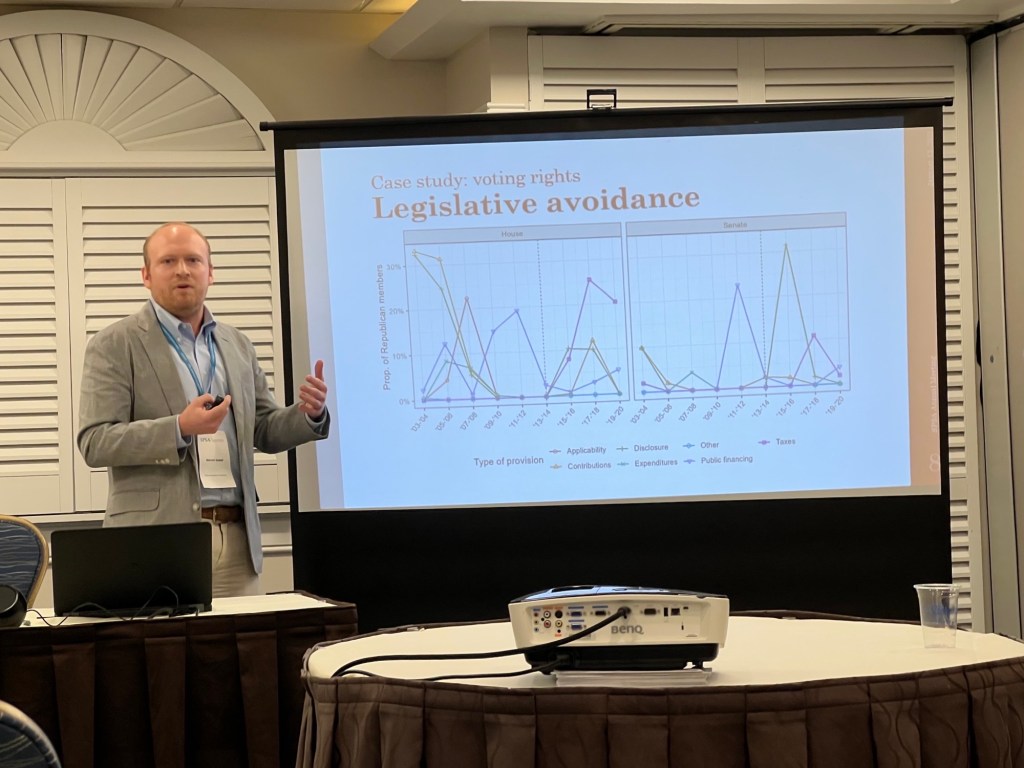
In January 2022, I published an op-ed in the Chicago Tribune with Tonja Jacobi titled, “In voting rights battle, moderate Republicans are allowed to duck the issue”. In the piece, we argued that moderate Republican Senators (especially Mitt Romney, Lisa Murkowski, and Susan Collins) deserved heightened public scrutiny for their position-taking (or lack thereof) on proposed voting rights legislation.
 Warren Snead